Optomechanical Resonator Design
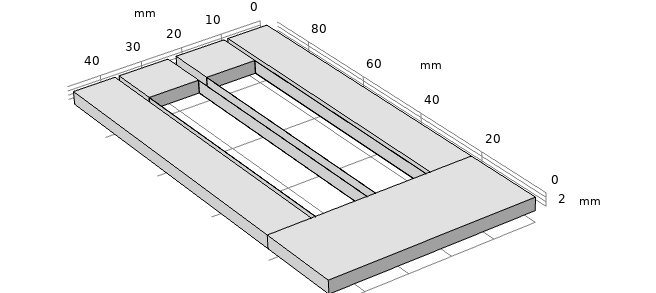
In LASSO, we design our resonators according to specifications such as the required resonant frequency. We use software such as Python, MATLAB, SolidWorks, and COMSOL to analyze material, shape, gravity, and other constraints, including whether the resonator will be used on Earth or in space and whether any objects, such as mirrors, will be mounted on it. We optimize the resonator for the required resonant frequency and stress based on shape, material, Q‑factor, noise, and expected performance. If the design is feasible, we proceed with fabrication.

Optomechanical Resonator Modelling
In LASSO, we design and model mechanical resonators to understand how their acceleration sensitivity depends on geometry and material. When designing resonators, we calculate the acceleration sensitivity that will be achieved for a given topology and resonance frequency. This sensitivity is limited by readout noise and the resonator’s intrinsic noise.
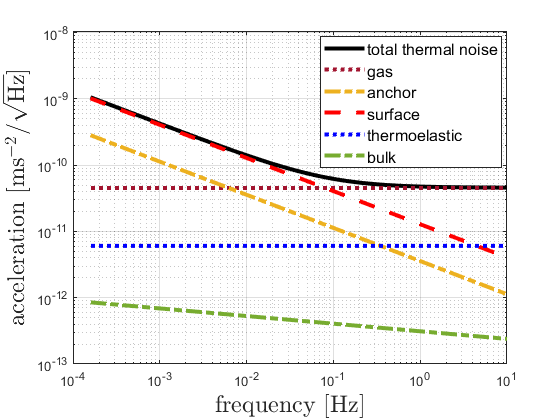
Intrinsic noise, sometimes referred to as thermal noise, represents the limiting sensitivity that can be achieved regardless of readout quality and depends largely on the resonator’s topology and material. By optimizing the resonator’s dimensions and carefully selecting the material, we at LASSO can minimize intrinsic noise.
Thermal motion in the resonator is due to the dissipation of elastic energy through numerous mechanisms such as defects in the crystal lattice within the material, damage to the resonator’s surface, bending caused by spontaneous temperature fluctuations, air resistance, and acoustic coupling with the mounting equipment.
We use models of these dissipation mechanisms, whether those found in the literature or created using finite element analysis software, to predict the thermal noise of a given resonator and then optimize its geometry to reduce that noise.
Optomechanical Resonator Fabrication
Nano Fabrication
LASSO is designing compact optomechanical sensors for use in several projects, such as the space geodesy and inertial sensing initiatives. These types of sensors can be costly. Our group is currently working to fabricate monolithic mechanical sensors using the facilities available at the Wyant College of Optical Sciences here at the University of Arizona. We are pursuing the fabrication of mesoscale integrated photonic systems, as well as compact low-frequency systems on different materials. These components will be used in future inertial sensing systems for applications on ground and in space.
 LASSO - Laboratory of Space Systems and Optomechanics