

Research Areas
Ultrafast Laser Stress Figuring
Focusing ultrafast laser pulses, with sub-picosecond pulse duration, into dielectric materials generates the required stress state for general figuring, and can be used iteratively. In ultrafast laser stress figuring (ULSF), we focus an ultrafast laser in a transparent substrate like fused silica, and we choose the 3-dimensional positions and laser parameters to generate a desired stress state at each point on the mirror. The stress bends the mirror from its original shape to a desired shape.

(Left) ULSF entails focusing an ultrafast laser at multiple depths in a mirror substrate wherein the stress induced by the laser spots bends the substrate to match the target state. (Right) ULSF process flow
Relevant Publications
K. A. Laverty and B. D. Chalifoux, “Ultrafast laser stress generation landscape in fused silica,” Opt. Express, OE 33, 24787–24799 (2025). https://doi.org/10.1364/OE.561444
B. D. Chalifoux, K. A. Laverty, and I. J. Arnold, “Ultrafast laser stress figuring for accurate deformation of thin mirrors,” Opt. Express 30, 17767–17780 (2022). https://doi.org/10.1364/OE.456679
X-ray Optics
We aim to build high-resolution X-ray mirror modules for future X-ray telescope observatories. Our mirror concept is Flex Modules, which are epoxy-free all-glass mirror assemblies in which the mirror segments are simultaneously figured and aligned via ULSF after coating and assembly, i.e., final-step figuring. Flex Modules use segmented mirrors called Flex Segments, which are mirror segments in which the outermost region is a support frame that the mirror surface is connected to via flexures.
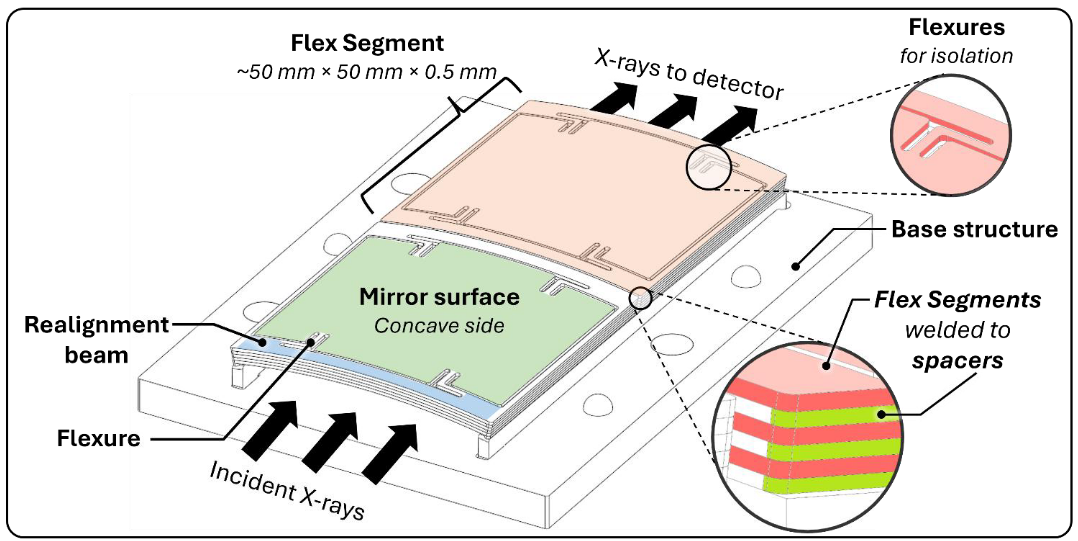
Flex Module prototype design

(Left) flat Flex Module and (right) slumped mirror module prototypes for process step technology development of Flex Modules
Relevant Publications
B. D. Chalifoux, B. D. McElwain, C. C. Hokin, H. R. Tailor, S. Hillman, W. C. Esher, I. J. Arnold, K. A. Laverty, D. Synan, D. N. Gurgew, and C. J. Oh, “Flex modules: a path to high-resolution x-ray imaging via final-step figuring,” in Proc. SPIE (2025), Vol. 13626, p. 136260X. https://doi.org/10.1117/12.3064123
B. D. McElwain, S. Hillman, H. Tailor, I. J. Arnold, L. P. Keerthi Gurunathan, W. C. Esher, and B. D. Chalifoux, “Fabrication and assembly of Flex Module prototypes,” in Proc. SPIE (2025), Vol. 13626, p. 136260Y. https://doi.org/10.1117/12.3065506
Ultra-Stable Composite Metrology
Future space telescopes and precision optical systems demand structural materials with sub-ppb/K dimensional stability across their operating temperature range. We are developing a novel displacement measuring interferometer to characterize the coefficient of thermal expansion (CTE) of ultra-stable composites under development for NASA. The program also includes custom optomechanical hardware — including a mirror with an integrated flexure — that interfaces directly inside the composite sample to mitigate end effects and enable high-sensitivity CTE. The goal is a metrology capability that supports material screening and qualification for the next generation of dimensionally stable space structures

Measuring the coefficient of thermal expansion of a carbon fiber tube using an etched mirror with integrated mounting flexures to minimize end effects.

custom flexured mirror used for measuring coefficient of thermal expansion of carbon fiber tubes
Relevant Publications
K. J. Ettinger, L. P. K. Gurunathan, I. J. Arnold, and B. D. Chalifoux, “Tunable ultra-stable composites and laser interference dilatometry,” in Optomechanical Engineering 2025 (SPIE, 2025), Vol. 13599, p. 135990J. https://doi.org/10.1117/12.3064152