Graves on Infrared Deflectometry

graves

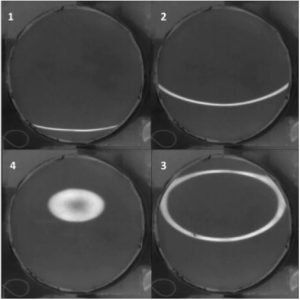
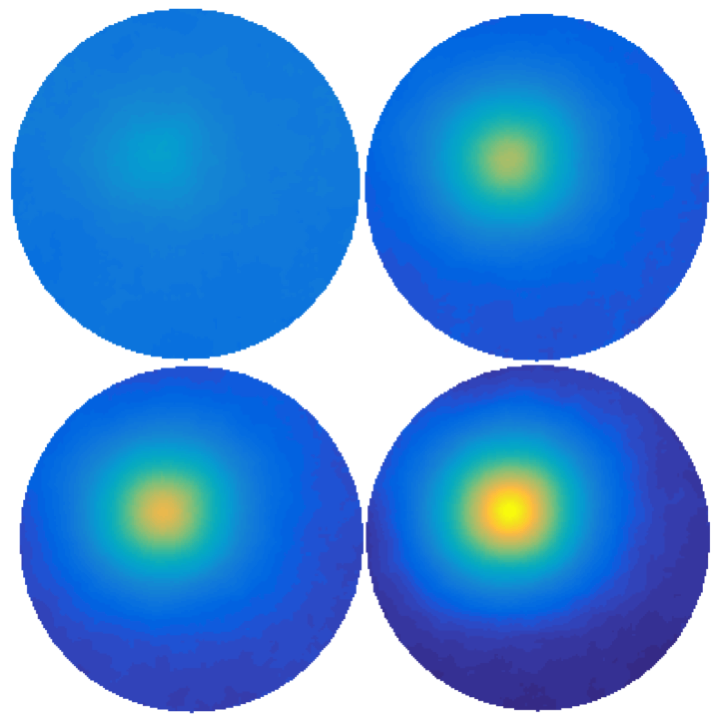
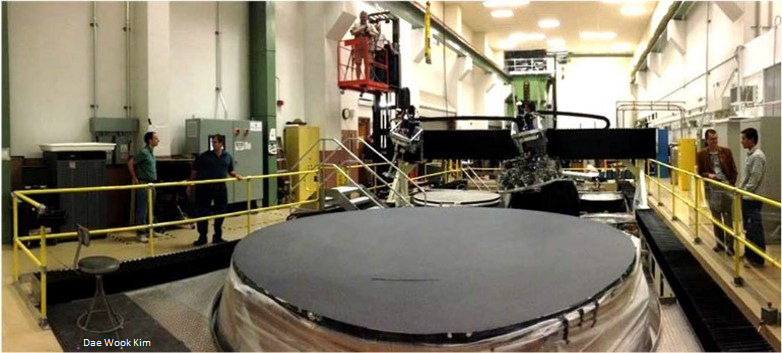
This week we discuss infrared deflectometry and its applications towards large optics fabrication. By utilizing a long wavlength, surfaces that are not reflective in the visible are able to be tested using deflectometry. Some of the challenges that went into the IR deflectometry system, including source design, geometry considerations, and source errors are discussed. Additionally, Graves comments on his experience in being part of the team that performed metrology for the 4.2 m DKIST primary mirror.

For more information on infrared deflectometry please read:

IR_Deflectometry_SPIE_Newsroom_2015_DKim

Thank you for listening to this weeks episode. If you have any questions or comments please let us know. Additionally, we are always looking for new topics to cover, so please email or comment to let us know who should be in the spotlight in the future.

Cheaper, Faster, Better- Trumper on Instantaneous Phase Shifting Deflectometry

Trumper-4-17-2017

We sit down this week with Isaac Trumper to discuss his new work on an instantaneous phase shifting deflectometry system he developed and deployed on an iPhone. His work allows for dynamic metrology of optical surfaces in an extremely low cost form.

Background:

Deflectometry is a specific method used to optically measure a surface shape. The concept is based on a simple principle, if a candle is lit and we hold it at a known position in front of a reflective surface, also at a known position, and then move our eye until we see the candle, we can calculate the slope of the mirror. By doing this for all points on a mirror, we can integrate the surface slopes to arrive at a surface profile. If instead of a candle we upgraded to a screen, we can now display very complex images to illuminate the entire mirror surface at once, allowing us to calculate all the surface slopes without moving our source. A source image used commonly is a sinusoidal pattern, which is phase shifted a number of times. This pattern is presented in the x and y orthogonal directions to obtain x and y slope maps, which allows for the calculation of a complete surface map. One previous limitation to this method is that the screen had to display each phase shifted sinusoid consecutively. This is no longer the case, as Isaac Trumper recently has proven that the phase shifts can be encoded into different color channels, red, green, and blue, of the screen. This allows for three simultaneous phase shifted sinusoids to be presented at once. Additionally, using Fourier transform techniques, Trumper was able to encode the x and y sinusoid patterns simultaneously, allowing for one screen to be showing a total of 3 unique patterns in the x direction, and 3 unique patterns in the y direction; i.e. 6 multiplexed channels at once. This allows for a single display and image capture to entirely capture all the required information to completely solve for the surface profile of your optic under test.

For a complete description of the work done, please see Isaac Trumper’s recent paper, located at oe-24-24-27993_DKim

Peter’s (ZYGO Executive Director of R&D) Invited Talk

LOFT group members shouldn’t miss this great talk (Invited_Talk_Peter_Zygo) by Peter from ZYGO. If you have any question regarding the talk, please, contact Dae Wook Kim (dkim@optics.arizona.edu).

Peter is a Physics PhD working in precision optical measurements, and is currently the Executive Director of R&D at ZYGO and head of an R&D Team comprised of 7 PhD scientists. ZYGO R&D works on the invention, concept demonstration and development of new optical instruments. Peter is a fellow of the SPIE and of the OSA, has published 150 technical papers, tutorials and book chapters on a wide range of topics, and is an inventor for 132 issued US patents for optical instrumentation. As R&D Group Leader and a Principal Scientist, Peter has contributed to every ZYGO metrology product line since 1992.

The Large Optics and Fabrication Group

Picture1

This week we introduce the first series for The Spotlight Report, which will be the LOFT Group. The LOFT Group (large optics and fabrication technology) focuses on metrology research, such as CGH’s and deflectometry, as well as fabrication breakthroughs, including polishing methods, materials, and control. Tune in to see what the LOFT Group is all about and to get an idea of the topics we will be covering in the coming episodes of this series!

Also, this week we mentioned swing arm profilometry, which was indeed created in the LOFT Group. You can find the journal article discussing the swing arm profilometer at:

Anderson Proc SPIE 2536