

Research
Research interest: Our main interest is on furthering of our basic understanding of the behavior of ultrafast intense optical field in non-linear matters. In particular, we develop of the next generation of light sources for telecommunications, biomedical imaging and other important applications.
Laser development
Femtosecond laser pulse generation with a fiber taper embedded in carbon nanotube/polymer composite (Opt. Lett. 2007)
This new saturable absorber (SA) design was proposed and demonstrated by our group in 2007. The SA is based on a fiber-taper embedded in carbon nanotube/polymer composite. The interaction is through the evanescent field of the fiber taper. The main advantages of this class of SA are compact, fiber-compatible and high damage threshold. We have demonstrated the use of the SA for fiber laser mode-locking in a wide range of wavelengths including 1micron, 1.5 micron and near 2micron. This SA technology was commercialized in 2010 and is currently being used in about a dozen of laboratories around the world and also in 4 teaching classes.
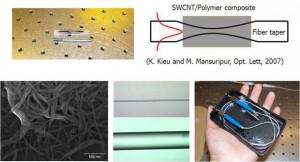
Generation of Few-Cycle Pulses From an Amplified Carbon Nanotube Mode-Locked Fiber Laser System (PTL, 2010)
We report a simple femtosecond fiber laser system based on carbon nanotube saturable absorber that is capable of generating 14-fs pulses (containing less than 4 optical cycles) with optical spectrum extending from 1000 nm to around 1500 nm.
This is the first demonstration of a handheld all-fiber laser system capable of producing ultrashort optical pulses containing only a few cycles. The laser is useful for many applications such as ultrafast pump/probe spectroscopy, OCT, multiphoton imaging, etc.

Ultrafast laser sources for multiphoton microscopy
We have been devoting much of our time to develop advanced ultrafast laser sources for biomedical multiphoton imaging. Multiphoton (or nonlinear) imaging is a powerful new imaging modality that may have huge impact in practical disease diagnostics and screening. Significant research progresses have been made in the field in the last decade and multiphoton imaging has become a valuable tool in many research laboratories around the world. However, there is an outstanding challenge that is preventing this technique to be applied in hospitals for real applications. Current laser technology that most of research was done with is based on bulky solid-state laser systems which have no chance of getting out of the lab. Thus, there is a strong need in the development of new compact, low cost and easy-to-use laser sources to help move multiphoton imaging into the real world. Fiber lasers can be the right platform due to their unique advantages in terms of compactness, robustness and cost-effectiveness. In our opinion, fiber lasers with the mentioned above SA technology are of particular interest which can become a universal ultrafast laser platform for not only multiphoton imaging but most of other applications where ultrashort optical pulses are needed.
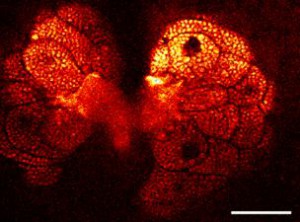
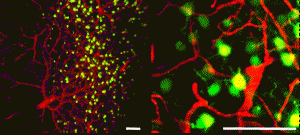
500 mm into mouse cortex, where the soma of layer 5 pyramidal neurons are clearly visible surrounded by capillary beds (scale bars are 75 mm ). The images were taken with a high power femtosecond fiber laser working at around 1030nm (in collaboration with Prof. Wise and Prof. Schaffer at Cornell).
Laser applications:
Frequency comb and precision spectroscopy:
Low noise erbium fiber fs frequency comb based on a tapered-fiber carbon nanotube design (Opt. Express 19, 5313-5318 (2011), in collaboration with Prof. Jones group)
We report on a low noise all-fiber Er fs frequency comb based on a simple and robust tapered-fiber carbon nanotube (tf-CNT) design. By identifying and minimizing the dominate sources of noise and optimizing the fiber laser parameters, we show that the free-running linewidth of the carrier-envelope offset frequency (fceo ) can be comparable to or better than that of other (more complex) fiber laser based frequency combs. A free-running fceo linewidth of ~ 20 kHz is demonstrated, corresponding to an improvement of ~30 times over previous work based on CNT mode-locked fiber lasers. We also demonstrate the use of an external-cavity acousto-optic modulator to stabilize fceo with a 300 kHz feedback control bandwidth. The offset frequency is phase-locked with an in-loop rms phase noise of ~ 30 mrad. We show a resolution-limited linewidth of ~1 Hz, demonstrating over 90% of the comb power within the coherent fceo signal. The results demonstrate that the inexpensive, robust, and relatively simple tf-CNT fiber laser can provide for a compact and high-performance fs frequency comb. Compared to other CNT-based designs, the use of a tapered-fiber CNT structure further enables the possibility to develop higher power and higher repetition rate fiber frequency combs due to the inherently higher damage threshold of the robust design.
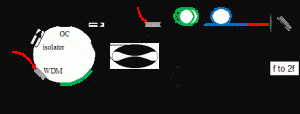
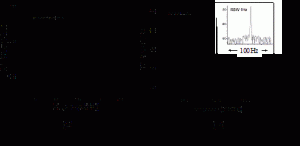
(a) Free-running linewidth of fceo measured with an electronic spectrum analyzer and 300 Hz video resolution bandwidth. Larger signal at ~42 MHz corresponds to the fundamental repetition rate of the laser. (b) Stabilized carrier envelope offset frequency recorded with 1kHz video resolution bandwidth. Inset shows resolution bandwidth limited 1 Hz linewidth. RBW: resolution bandwidth.
All-optical switching:
Demonstration of Zeno switching through inverse Raman scattering in an optical fiber (Opt. Express 19, 12532-12539 (2011))
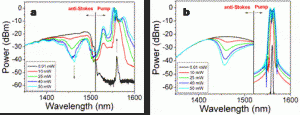
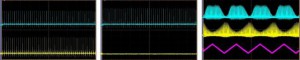
We report the observation of Zeno switching through an inverse Raman scattering (IRS) process in an optical fiber. In IRS, light at the anti-Stokes frequency is strongly attenuated in the presence of a pump field, allowing it to be used for all-optical switching and modulation. Our observed level of induced absorption via IRS in the optical fiber is > 20dB in a time scale of less than 5 ps. The full Raman response spectrum was extracted experimentally and excellent agreement was found between the experimental data and theoretical modeling of IRS.
Coherent Raman microscopy:
High power all-fiber picosecond laser system for Coherent Raman Microscopy (Opt. Lett. 34, 2051-2053 (2009)-in collaboration with Prof. Wise at Cornell and Prof. Xie at Harvard)
We report a high power picosecond fiber laser system for coherent Raman microscopy (CRM). The fiber laser system generates 3.5 ps pulses with 6 W average power at 1030 nm. Frequency-doubling yields more than 2 W of green light, which can be used to pump an optical parametric oscillator to produce the pump and Stokes beams for CRM. Detailed performance data on the laser and the various wavelength conversion steps is discussed, together with representative CRM images of fresh animal tissue obtained with the new source.
CARS images: a) CARS image at the CH2 stretching frequency (2845cm-1) showing the lipid distribution in the stratum corneum of wild-type mouse skin. b) CARS image of the lipid distribution in the sebaceous gland 30mm deep in tissue. Scale: 20mm.