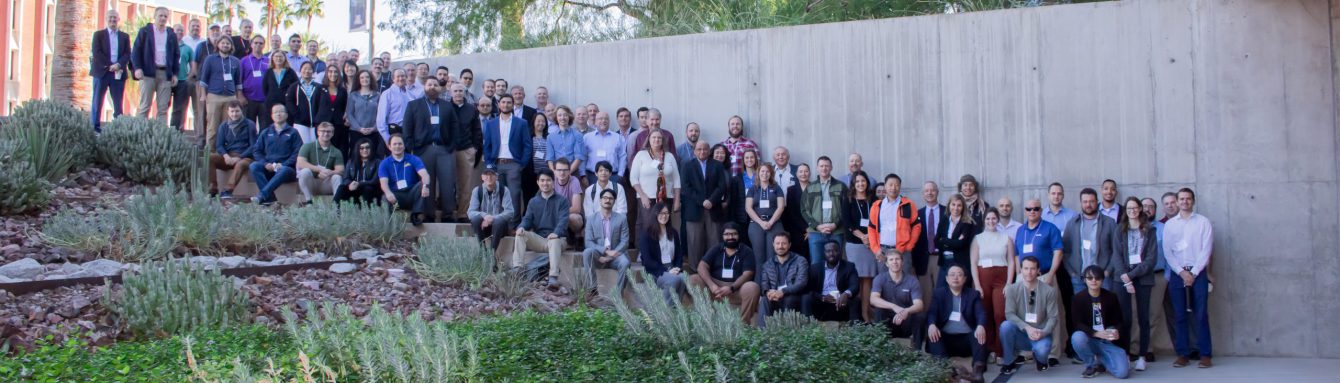
Event Details & Agenda
Event at a Glance!
_______
Monday
oct 19
tuesday
oct 20
wednesday
oct 21
- Alumni Career Panel and Lunch
- Student Poster Session
- Corporate Showcase
- Networking Breakfast (Reserved for OSC Faculty, Attending Industry Members, and by Invite Only)
- Keynote & Presentations
- Lunch at Bear Down Building
- Photonics Panel
- Open Labs
- Continental Breakfast (Reserved for Attending Industry Members)
- Student Interviews
Speakers
_______

Garrett Cole
Nelson E. Claytor Endowed Chair in Optical Sciences Associate Professor of Optical Sciences

Title, Abstract, and Bio
Title:
Precision Photonics: From Optical Clocks to Gravitational Waves
Abstract:
Advances in precision photonics are now enabling capabilities that were once considered unattainable, from clocks capable of measuring minute changes in Earth’s gravitational potential to detectors that observe collisions between black holes and neutron stars across the universe. These achievements reflect decades of progress in optics and photonics, yet they represent only the beginning of what will ultimately be possible. In this talk, I will share my personal journey through academia, national laboratories, industry, and entrepreneurship while discussing how innovations in optical materials and manufacturing have helped drive this progress. Using the development and commercialization of crystalline optical coatings as a case study, I will illustrate how fundamental research can evolve into an enabling technology and reflect on lessons learned during the transition from the laboratory to the commercial marketplace. I will also explore emerging opportunities including quantum technologies, integrated photonics, advanced laser systems, and next-generation sensing platforms. As optics continues to expand its influence across nearly every technical sector, strong partnerships between universities and industry will play an increasingly important role in transforming scientific discovery into real-world impact. My goal is to highlight not only the remarkable advances already achieved, but also the exciting opportunities that lie ahead for the broader optics and photonics community.
Bio:
Assoc. Prof. Garrett D. Cole is the Nelson E. Claytor Endowed Chair in Optical Sciences at the Wyant College of Optical Sciences. Cole earned his Ph.D. in Materials Science and Engineering from the University of California, Santa Barbara, in 2005. He began his career at Aerius Photonics and later held research positions at Lawrence Livermore National Laboratory, the Austrian Academy of Sciences, and Universität Wien. In 2012, he co-founded Crystalline Mirror Solutions, a spin-off commercializing semiconductor supermirrors for precision metrology. The company was acquired by Thorlabs in 2019, where Cole served as Managing Director of Thorlabs Crystalline Solutions before joining the faculty at U of A.
His work has earned international recognition, including the LIGHT2015 Young Photonics Entrepreneur Award, the Berthold Leibinger Innovationspreis, the SPIE Prism Award, and election as a Fellow of Optica. Named to the Photonics100 in 2024, Cole continues to advance optical coating technologies, mid-infrared applications, and quantum hardware solutions while mentoring the next generation of optical scientists.

Jeff Pyun
Joint Professor of Optical Sciences
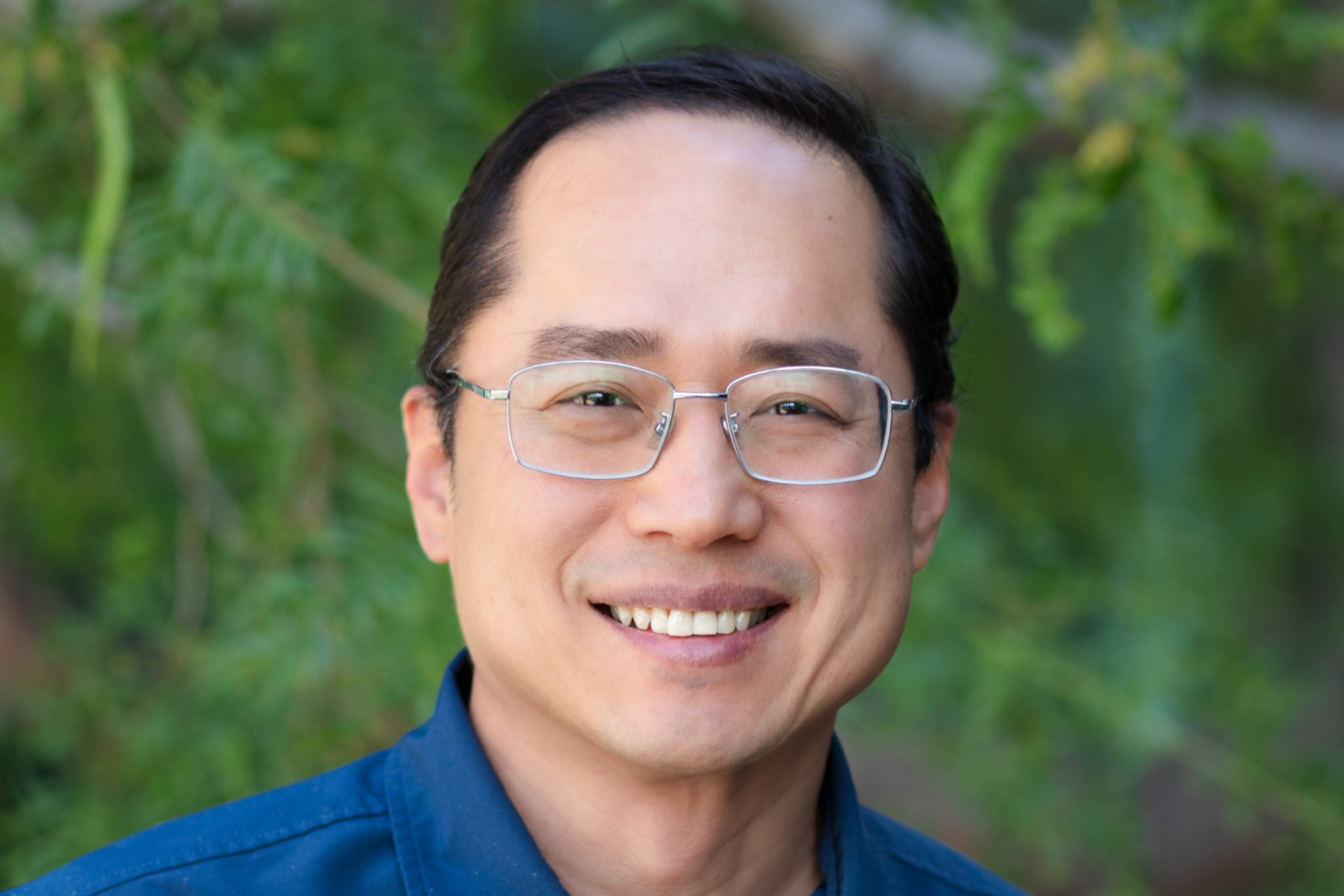
Abstract and Bio
Title: From Elemental Sulfur to Photopatternable Polymers: A New Solution for Photonic Hardware
Abstract: Polymeric materials offer compelling opportunities for scalable optical and photonic devices, but conventional optical polymers remain limited by low refractive indices and restricted infrared transparency. Our groups at the University of Arizona have developed new classes of optical polymers using molecular design and sulfur-rich chemistry to address these limitations. Early work on refractive index contrast polymers enabled direct photochemical patterning of polymer waveguides and optical interconnects. More recently, high refractive index polymers derived from commodity sulfur feedstocks enabled single-mode waveguides, optical splitters, ring resonators, and phase-shifted Bragg gratings. Our current efforts focus on photopatternable sulfur plastic glasses designed for thin-film optical manufacturing. A new disulfide glass photopolymer (Photo-DSG) combines high refractive index and optical transparency with maskless photolithography and UV-assisted nanoimprint lithography. Photo-DSG enables high-fidelity micro- and nanoscale patterning for diffraction gratings, two-dimensional photonic structures, and phase-only computer-generated holograms. Together, these results establish sulfur polymer chemistry as an emerging materials platform for scalable integrated and diffractive photonics spanning visible and infrared wavelengths.
Bio: Professor Jeffrey Pyun is currently a Professor in the Department of Chemistry & Biochemistry and a Professor in the Wyant College of Optical Sciences at the University of Arizona. Prof. Pyun’s research interests focus on the synthesis, self-assembly, characterization and device evaluation of novel polymers, nanoparticles, and nanocomposites materials. He is currently working on materials that are anticipated to broadly impact the areas of optical polymeric materials, photonics, sustainable polymer chemistry, sulfur utilization, photocatalysis-solar fuels and energy storage technologies. In 2002, he obtained his Ph.D. in Chemistry with Prof. Krzysztof Matyjaszewski at Carnegie Mellon University working in the area of controlled radical polymerization applied to the synthesis of organic/inorganic hybrid materials. He then moved on to postdoctoral research in a joint position with Prof. Jean M.J. Fréchet and Prof. Craig J. Hawker at the IBM Almaden Research Center from 2002-2004 focusing on the synthesis of complex macromolecular architectures for catalysis. Since 2009, he has also served as a World Class University Professor and Adjunct Professor, in the School of Chemical & Biological Engineering at Seoul National University. Prof. Pyun’s research contributions has also been recognized by the University of Arizona with the Innovation and Impact Award from Tech Launch Arizona and was named the Academic Innovator of the Year in 2017 from the State of Arizona. He was also appointed as a Kavli Fellow (2011), an American Chemical Society PMSE Fellow (2019), admitted into the National Academy of Inventors (2019) and named a Fellow of the Royal Society of Chemistry (2021). Prof. Pyun was recently named the first recipient of the University Distinguished Innovation and Entrepreneurship Award from the University of Arizona (2022). Prof. Pyun is also an Adjunct Professor to the faculty at Pusan National University in the Department of Chemistry and a Visiting Professor, Adjunct Professor at Korea University in the Department of Chemical Engineering since 2020 and Visiting Professor in the College of Engineering at Hanyang University.

Daniel Soh
Associate Professor of Optical Sciences
Abstract and Bio
Title: Computing Before the Detector: Optical Reservoirs Computing for Low-Power Inference
Abstract: Optical front ends generate data faster than the electronics behind them can afford to digitize, move, and multiply. Reservoir computing proposes a different division of labor: let an optical system’s own dynamics perform the nonlinear feature map, and train only a linear readout. All-optical versions of this already run on real hardware.
Bio: Daniel Soh is an Associate Professor of Optical Sciences and of Electrical and Computer Engineering at the University of Arizona, where he leads the Soh Lab. His research spans quantum and photonic reservoir computing, squeezed light, and quantum sensing. He joined Arizona after 14 years at Sandia National Laboratories, holds PhDs from Southampton and Stanford, and is an inventor on 16 U.S. patents.

Yuzuru Takashima
Professor of Optical Sciences

Abstract and Bio
Title: Controlling light with MEMS SLMs for optical cross-connect switch
Abstract:
We overview emerging applications employing beam and image steering with Micro Electro Mechanical System (MEMS) based Spatial Light Modulators (SLMs) as well as their potential use cases for emerging AI data center applications: Optical Cross-connect Switch, and Fiber to PIC couplers.
Bio:
Dr. Yuzuru Takashima is a tenured full professor at James C. Wyant College of Optical Sciences of University of Arizona. His research focus is MEMS-based lidar for automotives and AR near to eye displays, optical devices for AI data centers. Prior to joining the University of Arizona, he was a research staff at Stanford University where he conducted research and development of high-density holographic data storage systems and nano-photonic electron beam generators. He was employed as an optical engineer at Toshiba Corporation in Japan and developed ultra-precision manufacturing process for optical components. He is a fellow of SPIE and senior member of OPTICA. He serves as a general co-chair of SPIE Industrial Optical Systems and Devices (iODS), and 2026 OPTICA 3D conference. He received B.S. in Physics from Kyoto University in Japan and M.S. and Ph.D. in Electrical Engineering from Stanford University.

Weimin Zhou
Assistant Professor of Optical Sciences
Abstract and Bio
Title: Computational and AI-Enabled Image Science
Abstract: Recent advances in computational methods and artificial intelligence (AI) are creating new opportunities for analyzing and optimizing imaging systems. In this talk, I will present methodological developments in computational and AI-enabled image science. I will first discuss how deep generative models can be used to learn stochastic object models from imaging data. I will then demonstrate how learned generative models can facilitate Bayesian ideal observer computation through Markov chain Monte Carlo methods. Next, I will present a novel framework for extracting task-relevant features from high-dimensional imaging data, enabling efficient observer analysis in a low-dimensional feature space. Finally, I will highlight how these computational tools can support task-based image quality assessment and guide the development of intelligent imaging systems.
Bio: Weimin Zhou is an Assistant Professor at the University of Arizona, where he directs the Computational Imaging and Visual Intelligence Laboratory (CIVIL). He holds dual appointments in the Wyant College of Optical Sciences and the Department of Radiology & Imaging Sciences, and additional appointments in the Department of Biomedical Engineering and the Program in Applied Mathematics. He is a recipient of the SPIE Community Champion Award and the SPIE Medical Imaging Cum Laude Award. His research lies at the intersection of image science and machine learning, with a focus on developing computational models and AI methods for assessing and improving image quality.
Image Science

Yiqing Dong, MS Student
Title: Yeo-Johnson-transformed channelized observer for signal detection in medical imaging
Abstract and Bio
Presenting on Oct 20 at 10:30 – 10:35am
Abstract:
Bio:

Gordon Hageman, PhD Student
Title: Methods for Referencless Phase Imaging
Abstract and Bio
Presenting on Oct 20 at 11:35 – 11:40am
Abstract:
Bio:

Alaa Hamdoh, PhD Student
Title: Optical Fingerprinting: Authenticating Natural and Synthetic Gemstones via Transmission Polarization Imaging
Abstract and Bio
Presenting on Oct 20 at 4:20 – 4:25am
Abstract:
Intra-class transmission signatures further distinguish growth origins and manufacturing variances among identical material pairs. Visually identical natural and CVD diamonds differ: natural diamonds show macroscopically symmetric patterns and a consistent secondary DoLP peak at 0.46, whereas synthetic CVD crystals show chaotic AoLP fragmentation and asymmetric DoCP distributions from growth-induced lattice stress. Transmission profiles also assess manufacturing tolerances by detecting facet-alignment discrepancies in isotropic CZ pairs and confirm exceptional crystal-axis alignment consistency across separate synthetic moissanite batches. These findings show that transmissive polarization metrology provides a robust, mathematically reliable signature for material verification and industrial quality control.
Bio:

Nate Smith, PhD Student
Title: Quantification of Vascular Development Surrounding Artificial Pancreas Using Contrast‑Enhanced μCT
Abstract and Bio
Presenting on Oct 20 at 10:35 – 10:40am
Abstract:
Bio:
Optical Engineering

Kyle Ettinger, PhD Student
Title: Vibration imaging simulations using doublet-pulse digital holography
Abstract and Bio
Presenting on Oct 20 at 11:25 – 11:30am
Abstract:
Bio:

Feiyi Shen, PhD Student
Title: Gaze-Contingent Head-Mounted Displays via Adaptive Pupil Steering for High Light Efficiency and Brightness Uniformity
Abstract and Bio
Presenting on Oct 20 at 11:30 – 11:35am
Abstract:
Bio:

Shriniketh Sreevatsan, PhD Student
Title: Ultrafast Imaging at MHz Burst Rates Using a Digital Micromirror Device
Abstract and Bio
Presenting on Oct 20 at 11:20 – 11:25am
Abstract:
Bio:
Optical Physics

Isack Padilla, PhD Student
Title: Non-Markovian delay-assisted sensing with waveguide-coupled quantum emitters
Abstract and Bio
Presenting on Oct 20 at 3:55 – 4:00pm
Abstract:
Bio:

Sadafi Neshat, PhD Student
Title: Toward a reconfigurable photonic integrated mode sorter for optomechanical sensing
Abstract and Bio
Presenting on Oct 20 at 3:50 – 3:55pm
Abstract:
on a free-space multi-plane light converter (MPLC) interfaced with a low-loss, tunable 3×3 Clements interferometer mesh implemented on a photonic integrated circuit (PIC). The Clements mesh implements arbitrary unitary transformations through thermo-optic phase shifting, enabling dynamic control of the relative amplitudes and phases of multiple modes within a programmable spatial-mode processor. We present initial characterization of the fabricated PIC, including waveguide propagation losses as low as ∼ 0.015 dB/cm, together with coupling
loss and Mach-Zehnder interferometer performance. Finally, we analyze adaptive illumination and structured homodyne readout of a membrane resonator with a three-channel Hermite-Gauss mode transceiver, illustrating the potential of the scalable hybrid PIC-SPADE architecture for quantum-limited optomechanical sensing.
Bio:
Photonics

Tyler ten Broek, PhD Student
Title: Cryogenic Adiabtic Coupling Waveguides for Photonic Interconnects
Abstract and Bio
Presenting on Oct 20 at 4:25 – 4:30pm
Abstract:
With advances in aerospace and quantum information technologies, demand for cryogenically compatible photonics is growing. However, packaging technology for photonic integrated circuits (PICs) remains underdeveloped, especially for cryogenic applications. Available materials for these solutions are relatively limited, primarily semiconductors. The unique material properties of polymers, such as negative thermo-optic coefficients, low density, composition-tunable refractive index, and manufacturing versatility, allow them to fill gaps in this technological space.
We present a new cryogenically compatible polymer coupler that adiabatically expands the guided mode from a PIC to an optical fiber using a polymer waveguide that is evanescently coupled to a buried silicon nitride taper. The waveguides are made with commercially available polymers and are fabricated using UV lithography, making them low-cost to produce. Our focus is on demonstrating that these waveguides can be used in cryogenic environments through detailed characterization of their performance at low temperatures.
Bio:
Tyler ten Broek is a PhD student with the Wyant College of Optical Sciences at the University of Arizona. He received a B.S. in physics from the University of California Santa Barbara in 2019. His research interests include new optical materials for optical/photonics applications and photonics packaging.
Poster Presenters & Open Labs
_______
Monday, October 19, 2026, from 1:00 PM – 3:00 PM
Image Science
John Bass
PhD
Faculty Mentor: Florian Willomitzer
Poster Title
Covert Feedback-Free Alignment of Free-Space Optical Communication Systems
Yiqing Dong
MS
Faculty Mentor: Weimin Zhou
Poster Title
Yeo-Johnson-transformed channelized observer for signal detection in medical imaging
Gordon Hageman
PhD
Faculty Mentor: David Brady and Florian Willomitzer
Poster Title
Referenceless Computational Wavefront Sensing
Alaa Hamdoh
PhD
Faculty Mentor: Stanley Pau
Poster Title
Non-Destructive Authentication of Gemstones using Full-Stokes Polarization Imaging
Jaclyn John
PhD
Faculty Mentor: Meredith Kupinski
Poster Title
Detecting Ice-Water Phase Transition with LWIR Thermo-Polarimetry
Eden McEwen
PhD
Faculty Mentor: Jared Males
Poster Title
Optical gain three ways: comparing on-sky, real-time wavefront sensor gain calibrations with MagAO-X
Nate Smith
MS
Faculty Mentor: Lars Furenlid
Poster Title
Quantification of Vascular Development Surrounding Artificial Pancreas Using Contrast-Enhanced μCT
Tianyi Wang
PhD
Faculty Mentor: Florian Willomitzer
Poster Title
Robust and Accurate Iterative Slope Integration for Deflectometry
Aileen Zhang
PhD
Faculty Mentor: Dr. Yeran Bai
Poster Title
Chemical Identification of Microplastics at Sub-Micron Resolution Using Mid-Infrared Photothermal Imaging
Optical Engineering
Solvay Blomquist
PhD
Faculty Mentor: Daewook Kim
Poster Title
Tiny Observatory for Telescope Optimization (TOTO): testing algorithms for autonomous on-orbit alignment for space-based telescope systems
Mason Cipollini
MS
Faculty Mentor: Mehmetcan Akbulut
Poster Title
Distributed Fiber Acoustic Sensing for Seismic Detection
Jackson Dahn
PhD
Faculty Mentor: Felipe Guzman
Poster Title
ODIN: The Optomechanical Dris
Peter Dean-Erlander
PhD
Faculty Mentor: Dr. Ron Driggers
Poster Title
Downlink Speckle Mitigation via Polychromatic Laser Sources
Kyle Ettinger
PhD
Faculty Mentor: Mark Spencer
Poster Title
Vibration imaging simulations using doublet-pulse digital holography
Alana Gonzales
PhD
Faculty Mentor: Jennifer Barton
Poster Title
Development of a High-Resolution Imaging Probe for Detection of Inflammatory Breast Cancer
Amy Hermann
PhD
Faculty Mentor: Ronald Driggers
Poster Title
Field Comparison of SWIR and eSWIR Laser Range Gated Imaging
Ian Kingsolver
PhD
Faculty Mentor: Mark Spencer
Poster Title
Jitter coupling and uplink scintillation characterization for active tracking
Chance Lawrence
PhD
Faculty Mentor: Ronald Driggers
Poster Title
Integration time limits of strap-down pilotage sensors
Nicolas Malamug
PhD
Faculty Mentor: Mark Spencer
Poster Title
Benchtop Simulation of Atmospheric Turbulence in Optical Systems
Ryan McCrory
PhD
Faculty Mentor: Mark Spencer
Poster Title
Tiled array tilt compensation using a G-tilt approximation
Ramses Miranda Espino
PhD
Faculty Mentor: Felipe Guzman
Poster Title
Picometer optical metrology for future space observatories
Alfred Moore
PhD
Faculty Mentor: Ronald Driggers
Poster Title
Characterization of motion blur in quadcopter unmanned aerial vehicles
Patrick Nagle
BS
Faculty Mentor: Not provided
Poster Title
Determining optimal compression parameters for passive drone detection
Saruul Nasanjargal
PhD
Faculty Mentor: Felipe Guzman
Poster Title
Ultra-high precision thermometry
Trevor Owens
MS
Faculty Mentor: Mark Spencer
Poster Title
Uplink scintillation mitigation via incoherent beam combination
Sai Krishanth Pulikesi Mannan
MS
Faculty Mentor: Ewan S. Douglas
Poster Title
O Mirror Where Art Thou?
Jordan Rubis
PhD
Faculty Mentor: Ronald Driggers
Poster Title
Infrared Imaging in Rain
Feiyi Shen
PhD
Faculty Mentor: Hong Hua
Poster Title
Gaze-Contingent Head-Mounted Displays via Adaptive Pupil Steering for High Light Efficiency and Brightness Uniformity
Linden Solgonick
BS
Faculty Mentor: NA
Poster Title
Modeling an Infrared Liquid Crystal Eye Polarimeter in ZEMAX
Shriniketh Sreevatsan
PhD
Faculty Mentor: Yuzuru Takashima
Poster Title
Ultrafast Imaging at MHz Burst Rates Using a Digital Micromirror Device
Jeremiah Stoddart
PhD
Faculty Mentor: Felipe Guzman
Poster Title
ODIN (Optomechanical Distributed Inertial Navigation and Sensing)
Joshua Teague
PhD
Faculty Mentor: Ron Driggers
Poster Title
Electronic FMCW Active Imaging
Siddharth Vats
PhD
Faculty Mentor: Daniel Soh
Poster Title
Title TBD
Optical Physics
Lisset Ayala
PhD
Faculty Mentor: Mehmetcan Akbulut
Poster Title
Experimental demonstration of digital holography with an engineered beam
John Cobes
MS
Faculty Mentor: Mark F. Spencer
Poster Title
Impact of Beam Quality Degradations on Adaptive Optics Performance
Hope Dannar
PhD
Faculty Mentor: R. Jason Jones
Poster Title
Dual-Comb Spectroscopy of Heavy Metals
Liam Frank
PhD
Faculty Mentor: Jason Jones
Poster Title
Novel Spectroscopic Laser Systems for Nuclear National Security
Isack Padilla
PhD
Faculty Mentor: Kanu Sinha
Poster Title
Non-Markovian delay-assisted sensing with waveguide-coupled quantum emitters
Neshat Sadafi
PhD
Faculty Mentor: Dal Wilson
Poster Title
Toward a reconfigurable photonic integrated mode sorter for optomechanical sensing
Laura Sawyer
PhD
Faculty Mentor: Vanessa Huxter
Poster Title
Ultrafast time-resolved spectroscopy methods for photocatalytic and radical mechanisms
Qixuan Wan
MS
Faculty Mentor: Xiaodong Yan
Poster Title
Title TBD
Photonics
Diego Di Vanni
BS
Faculty Mentor: Not provided
Poster Title
Compact LIDAR system for distance and velocity measurements
Anwar Gatto
BS
Faculty Mentor: Not provided
Poster Title
Low Temperature Processes to Synthesize Novel Phase Change Glass Films
Kristy Hudgins
BS
Faculty Mentor: Not provided
Poster Title
Visualizing Molecular Sensing with a Whispering Gallery Mode Microtoroid Resonator in an Interactive 3D Environment
Olive Mehrer
PhD
Faculty Mentor: Mehmetcan Akbulut and Mark Spencer
Poster Title
Coherent Laser Illuminator for Interferometric Applications
Tyler ten Broek
PhD
Faculty Mentor: Robert Norwood
Poster Title
Cryogenic Adiabatic Coupling Waveguides for Photonic Interconnects
Tuesday, October 20, 2026, from 4:30 PM – 6:00 PM (click to view lists)
Explore the innovative research taking place throughout the Wyant College of Optical Sciences. During the Open Labs session, attendees are invited to visit participating laboratories, meet faculty and researchers, and learn about cutting-edge work in optical engineering, imaging, photonics, and physics.
Image Science
Polarization Ray Tracing
Faculty
Meredith Kupinski
Lab Leader
Abhiman Gupta
Location
Meinel Room 457
Image Science
Channeled Infrared Polarimeter
Faculty
Meredith Kupinski
Lab Leader
Jaclyn John
Location
Meinel Room 467
Image Science
Biomedical Applied Imaging Lab
Faculty
Yeran Bai
Lab Leader
Aileen Zhang
Location
Meinel Room 672
Image Science
EyePol
Faculty
Meredith Kupinski
Lab Leader
Lily McKenna
Location
Meinel Room 767
Optical Engineering
Optical coherence tomography (OCT) lab
Faculty
Rongguang Liang
Lab Leader
Yihan Wang
Location
Meinel Room 106E
Optical Engineering
3D printing optics
Faculty
Rongguang Liang
Lab Leader
Ruilin You
Location
Meinel Room 106J
Optical Engineering
Drone and Degraded Visual Environment Lab
Faculty
Ronald Driggers
Lab Leader
Jordan Rubis,
Amy Hermann
Location
Meinel Room 453
Optical Engineering
MOSAIC
Faculty
John Koshel
Lab Leader
Yong Xin “Kongo” Lai
Location
Meinel Room 664
Optical Engineering
Beam control and propagation lab
Faculty
Mark Spencer
Lab Leader
Kyle Ettinger,
Nico Malamug
Location
Meinel Rooms
658 & 660
Optical Engineering
3DVIS-Imaging & Display Lab
Faculty
Hong Hua
Lab Leader
Yue Tian,
Feiyi Shen
Location
Meinel Room 757
Optical Physics
Quantum Metrology and Quantum Sensing
Faculty
Cristian Panda
Lab Leader
Cristian Panda
Location
Meinel Room 106GH
Optical Physics
Dual-comb characterization of photonic chips
Faculty
Jason Jones
Lab Leader
Charlie Chisholm
Location
Meinel Room 656
Photonics
Photonic Integrated Circuit Test Lab
Faculty
Robert Norwood
Lab Leader
Dr. Kyung-Jo Kim
Location
Meinel Room 207
Photonics
Fiber Lasers and Devices/mid-IR Fiber Lasers
Faculty
Xiushan Zhu
Lab Leader
Joshua Lee
Location
Meinel Room 215
Photonics
Optical refrigeration
Faculty
Xiushan Zhu
Lab Leader
Shaam Nobel
Location
Meinel Room 227
Photonics
Photonic Materials and Devices Lab
Faculty
Robert Norwood
Lab Leader
Matthew Malaker
Location
Meinel Room 506/506A
Photonics
Ultrafast Fiber Lasers and Multiphoton Microscopy
Faculty
Khan Kiew
Lab Leader
Lam Nguyen
Location
Meinel Room 662
Photonics
Soft Nano-Photonic Systems Lab
Faculty
Euan McLeod
Lab Leader
Sid Liu,
Eliza Ballantyne
Location
Meinel Room 667
Image Science
Computational 3D Metrology, Wavefront Shaping, and Imaging through Scatter and Turbulence
Faculty
Florian Willomitzer
Lab Leader
Jiazgang Wang, James Taylor
Location
GCRB Room 255
Image Science
Transitional Optical Imaging Lab
Faculty
Dongkyun Kang
Lab Leader
Momoka Sugimura
Location
GCRB Room 321
Optical Engineering
Ultrafast laser processing systems
Faculty
Brandon Chalifoux
Lab Leader
Peikun Guo
Location
GCRB Room 015
Optical Engineering
LASSO – Laboratory of Space Systems and Optomechanics
Faculty
Felipe Guzman
Lab Leader
Felipe Guzman, Jose Sanjuan
Location
GCRB Rooms 045, 050, & 055
Optical Engineering
Active Imaging Lab
Faculty
Ronald Driggers
Lab Leader
Joshua Teague,
Peter Dean-Erlander
Location
GCRB Room 213
Optical Engineering
Pilotage Lab
Faculty
Ronald Driggers
Lab Leader
Chance Lawrence,
Alfred Moore
Location
GCRB Room 215
Optical Engineering
Takashima Advanced Lidar and Display Lab
Faculty
Yuzuru Takashima
Lab Leader
Jeff Chen, Tianyao Zhang, Yexin Pei, Avion Lowery, Keyang Wei, Shriniketh Nick Sreevatsan
Location
GCRB Rooms
225 & 325
Optical Engineering
UArizona CAVE Virtual Reality Lab
Faculty
Hong Hua
Lab Leader
Daniel Shevelev,
Qiwen Gan
Location
GCRB Room 245
Optical Physics
Quantum Optimechanics Lab
Faculty
Dalziel Wilson
Lab Leader
Morgan Choi, Atkin Hyatt, Dalziel Wilson
Location
GCRB Rooms 070
Panels & Discussions
_______
Monday, October 19, 2026, from 11 AM – 1:00 PM
Join the Wyant College of Optical Sciences for an engaging Alumni Career Panel & Lunch on October 19 from 11 a.m. to 1 p.m. in the Student Union Memorial Ballroom. Hear firsthand career advice from OSC alumni representing a range of professional paths, including entrepreneurship, aerospace and national laboratory research, and applications engineering in industry. Featured panelists include Joel Berkson (CEO, Fringe Metrology), Christine Bradley (Optical Engineer, NASA Jet Propulsion Laboratory), and Dominique “Nikki” Galvez (Application Engineer, Ansys). Bring your questions and gain valuable insights on career decisions, graduate school, work-life balance, and opportunities across the optics and photonics industry. Lunch will be provided.

Moderator: Katie Twitchell
Bio: Katie Twitchell graduated from the Wyant College of Optical Sciences in 2024 with her degree in Optical Sciences and Engineering and is currently a 3rd year Ph.D. Student in Optical Sciences. She is a National Defense Science and Engineering Graduate fellow, and her research focuses on hardware and software for Adaptive Optics. She currently works with the extreme adaptive optics system MagAO-X for the Magellan Telescope at Las Campanas Observatory in Chile, which has an end goal of imaging earth-like planets orbiting around other stars.

Joel Berkson
Bio: Joel Berkson is a native Tucsonan, earning his BS, MS, and PhD in Optical Sciences at UArizona. His PhD research focuses on techniques for building telescopes, but upon graduation, he founded Fringe Metrology in 2024 to advance precision metrology techniques for flat surfaces across a wide range of applications in semiconductors, materials, and other high sensitivity applications.

Christine Bradley
Bio: Christine L. Bradley received her B.S. and PhD degrees in Optical Science and Engineering from the University of Arizona, College of Optical Sciences. She is an Optical Engineer and Deputy Section Manager of the Optics & Spectroscopy Section at Jet Propulsion Laboratory in Pasadena, CA. She’s been awarded the JPL Charles Elachi Award and NASA Honor Achievement Medal for Exceptional Engineering in the development of novel alignment methodologies for the Earth Surface Mineral Dust Source Investigation (EMIT) Instrument.

Matthew Chidley
Bio: Matthew Chidley received his PhD in Optical Sciences from the University of Arizona in 2005. He has a BS and MS in Mechanical Engineering from the Ohio State University. In all, Matt has 28+ years of optics experience, including 21 years supporting airborne and space ISR applications. He specializes in optical design and analysis in Zemax, optical metrology, optical alignment, and optical system-level testing. Previously he served 7 years in technical management and currently leads RFI/RFP support to the CACI-Danbury Business Development group. Most importantly, Matt loves to mentor junior Optical Engineers.

Nikki Galvez
Bio: Dominique 'Nikki' Galvez graduated from the Wyant College's undergraduate program in May 2021 and the PhD program in August 2025. Her previous work at the College was in biomedical optics developing a micro-endoscope for early detection of ovarian cancer. Currently, she works as an Application Engineer at Ansys part of Synopsys, focusing on applications of Zemax OpticStudio and Lumerical. There, she designs new courses, content, and tools for OpticStudio and Lumerical learners, as well as directly supports users from across the field of optical sciences by helping bring their ideas into simulation.
Tuesday, October 20, 2026, from 2:10 PM – 3:10 PM
A panel discussion featuring leaders from academia and industry exploring the future of integrated photonics and semiconductor manufacturing.

Moderator: Robert Norwood
Professor of Optical Sciences, Professor of Materials Science and Engineering
Bio
Robert A. Norwood is a Professor in the Wyant College of Optical Sciences at the University of Arizona, where he performs research on photonic materials and devices. Dr. Norwood spent 15 years in R&D leadership positions in industry at both Fortune 100 corporations (Honeywell) and venture-capital backed startups (VP/CTO of Photon-X). He founded Norcon Technologies in 2017 to commercialize novel hybrid chalcogenide optical polymers developed at the University of Arizona. He is a world expert in integrated photonics, nonlinear optics and optical materials, with more than 215 refereed journal publications, 7 book chapters, 50 issued US patents, and 90 invited talks. Dr. Norwood has served on the program committees for OFC (sub-committee chair) and CLEO. He has been an associate editor of Optica, IEEE Photonics Technology Letters and Optical Materials Express. Dr. Norwood is a Fellow of Optica, SPIE and the National Academy of Inventors, as well as a member of APS. He holds the Ph.D. in physics from the University of Pennsylvania, and B.S.’s in physics and mathematics from MIT.

Garrett Cole
Associate Professor, Nelson E. Claytor Endowed Chair in Optical Sciences
Bio
Assoc. Prof. Garrett D. Cole is the Nelson E. Claytor Endowed Chair in Optical Sciences at the Wyant College of Optical Sciences. Cole earned his Ph.D. in Materials Science and Engineering from the University of California, Santa Barbara, in 2005. He began his career at Aerius Photonics and later held research positions at Lawrence Livermore National Laboratory, the Austrian Academy of Sciences, and Universität Wien. In 2012, he co-founded Crystalline Mirror Solutions, a spin-off commercializing semiconductor supermirrors for precision metrology. The company was acquired by Thorlabs in 2019, where Cole served as Managing Director of Thorlabs Crystalline Solutions before joining the faculty at U of A.
His work has earned international recognition, including the LIGHT2015 Young Photonics Entrepreneur Award, the Berthold Leibinger Innovationspreis, the SPIE Prism Award, and election as a Fellow of Optica. Named to the Photonics100 in 2024, Cole continues to advance optical coating technologies, mid-infrared applications, and quantum hardware solutions while mentoring the next generation of optical scientists.

Carl Dohrman
Associate Director, Raytheon Advanced Technology Business Unit
Bio
Dr. Carl Dohrman is an Associate Director leading a portfolio of integrated photonics programs for Raytheon’s Advanced Technology business unit. He is the principal investigator of Raytheon’s project under the DARPA HAPPI program, which is developing integrated chip-to-chip photonic interconnect technology. He is also the PI of a program to develop a domestic manufacturing line for thin film lithium niobate (TFLN) wafers. Prior to Raytheon, Carl was a SETA at DARPA for over eight years, where he served as a subject matter expert in integrated RF and photonic materials, devices, and systems. Carl’s Ph.D. thesis pioneered a novel multilayer substrate for heterogeneous integration, which was adopted by Raytheon on the DARPA COSMOS program to demonstrate advanced InP BiCMOS circuits. Carl received a B.S. degree from the University of Illinois and a Ph.D from MIT, both in materials science for electronics and photonics.

Nasser Peyghambarian
Professor Emeritus, Optical Sciences Chief Technical Officer
Bio
Nasser Peyghambarian, Phd, is the Technical Director of the Center for Semiconductor Manufacturing at University of Arizona (UA). He was the Chair of Photonics and Lasers at the College of Optical Sciences at UA (1991-2022) and Director of Optics Engineering at Amazon (2022-2025) developing augmented reality products. He was the Director of the National Science Foundation (NSF) Engineering Research Center (2008-2019) that was focused on introducing silicon photonics in data centers and access aggregation networks. He was the Associate Director of NSF Science and Technology Center (2006-2013) that was focused on introducing polymeric materials in silicon photonics and information systems. He has made significant contributions in the areas of photonics and optoelectronics and supervised more than 70 Phds, 80 MS and 100 postdocs and research scientists. He has over 700 scientific publications and has given 740 invited papers. His H-index is 102 based on Google Scholar. He has authored a textbook on “introduction to Semiconductor Optics” and has 45 patents granted. He founded several venture-funded start-ups including NP Photonics, CM Laser, and EARDG, two of which were acquired by Fortune 500 companies. He is a Fellow of the National Academy of Inventors, a Fellow of Optica, the American Physical Society and the Society for the Advancement of Science.

Srinivas Pietambaram
Senior Principal Engineer, Substrate Packaging Technology Development Organization (SPTD), Intel Corporation
Bio
Dr. Srinivas Pietambaram is a Senior Principal Engineer in Substrate Packaging Technology Development Organization (SPTD) of Intel Foundry, Intel Corporation. He is the technical lead responsible for driving disruptive packaging technologies and innovations with a recent focus on glass core substrates and Co-Packaged Optics. Srini is the recipient of the Intel Inventor of the year for 2023 and has authored over 1000 patent publications worldwide, 20+ technical papers in prestigious journals, and multiple trade secrets in packaging process / architecture / materials technologies, several of which are key to SPTD’s future technology packaging roadmap, He received his Ph.D. in Materials Science & Engineering from University of Florida in 2001 and worked with Motorola Labs for 10 years before joining Intel in 2011. Outside of work, Srini likes to spend time and travel with his family and enjoys listening to Indian Carnatic Music. He is also an avid sports fan with a special liking to Cricket and Gator Football.
Agenda
_______
Monday, October 19, 2026
| 10:00am – 1:00pm | IA Corporate Showcase Set Up |
| 11:00am – 1:30pm | |
| 1:30pm – 3:30pm | Student Poster Session |
| 2:00pm – 3:00pm | Headshots Photo Opportunity |
| 3:30pm – 6:30pm | |
| 5:00pm – 6:00pm | Headshots Photo Opportunity |
| 6:30pm – 7:00pm | Showcase Break Down and Pack-Up |
Tuesday, October 20, 2026
| 8:15 – 9:15 | Welcome Breakfast Reserved for OSC Faculty, Attending Industry Members, and by Invite Only |
| 9:00 – 9:15 | Group Photo |
| 9:15 – 9:30 | Workshop Welcome |
| 9:30 – 10:10 | Keynote Speaker |
| 10:10 – 10:30 | Faculty Talk |
| 10:30 – 10:35 | Student Talk Yiqing Dong, Yeo-Johnson-transformed channelized observer for signal detection in medical imaging |
| 10:35 – 10:40 | Student Talk Nate Smith, Quantification of Vascular Development Surrounding Artificial Pancreas Using ContrastEnhanced μCT |
| 10:40 – 11:00 | Break |
| 11:00 – 11:20 | Faculty Talk |
| 11:20 – 11:25 | Student Talk Shriniketh Sreevatsen, Ultrafast Imaging at MHz Burst Rates Using a Digital Micromirror Device |
| 11:25 – 11:30 | Student Talk Kyle Ettinger, Vibration imaging simulations using doublet-pulse digital holography |
| 11:30 – 11:35 | Student Talk Feiyi Shen, Gaze-Contingent Head-Mounted Displays via Adaptive Pupil Steering for High Light Efficiency and Brightness Uniformity |
| 11:35 – 11:40 | Student Talk Gordon Hageman, Methods for Referenceless Phase Imaging |
| 11:40 – 11:50 | Walk to Bear Down Gym |
| 11:50 – 1:10 | Lunch |
| 1:10 – 1:20 | Walk back to GCRB |
| 1:20 – 1:25 | Academics Update |
| 1:25 – 1:35 | Optics Technician Training at Pima Community College |
| 1:35 – 1:50 | SOCk & OFA Presentation Presenters: Isabella Aguilera-Cuenca (OFA), Aileen Zhang (OFA), Sofia Centeno (SOCk), Suhaani Sodhi (SOCk) |
| 1:50 – 2:10 | Industry Update Tom Hausken, Senior Science Advisor, Optica |
| 2:10 – 3:10 | PICS are the Pick: The Era of Photonic Integrated Circuits (PIC), Panel Discussion Nasser Peyghambarian, Garrett Cole, Carl Dohman, Robert Norwood |
| 3:10 – 3:30 | Break |
| 3:30 – 3:50 | Faculty Talk |
| 3:50 – 3:55 | Student Talk Sadafi Neshat, Toward a reconfigurable photonic integrated mode sorter for optomechanical sensing |
| 3:55 – 4:00 | Student Talk Isack Padilla, Non-Markovian delay-assisted sensing with waveguide-coupled quantum emitters |
| 4:00 – 4:20 | Faculty Talk |
| 4:20 – 4:25 | Student Talk Alaa Hamdoh, Non-Destructive Authentication of Gemstones using Full-Stokes Polarization Imaging |
| 4:25 – 4:30 | Student Talk Tyler ten Broek, Cyrogenic Adiabatic Coupling Waveguides for Photonic Interconnects |
| 4:30 – 4:50 | Break |
| 4:30 – 6:00 | Open Labs |
| 4:50 – 6:00 | Curriculum & Workforce Round Table |
Wednesday, October 21, 2026
| 8:00 – 9:00 | Continental Breakfast (Reserved for Attending Industry Members) |
| 9:00 – 5:00 | Student Interviews |
Thank You for Attending
We appreciate your participation in the Industrial Affiliates Workshop & Showcase.
Before you leave, please complete the following surveys:
Fall 2026 Industrial Affiliate Showcase & Workshop Event Evaluation
Participating Industry Partners
_______

Amazon Leo
A new era of internet is coming. Make seamless video calls, stream 4K videos, and accelerate downloads and uploads—all at once. Amazon Leo is designed to handle your whole family's internet needs with a fast, reliable connection.

Ansys
For more than 50 years, Ansys engineering simulation software has enabled innovators across industries to push boundaries using the predictive power of simulation. The next great leaps in human advancement will be powered by Ansys.

Edmund Optics
With over 80 years of experience, Edmund Optics® is a trusted provider of high-quality optical components and solutions, serving industries like Life Sciences, Biomedical, Industrial Inspection, Semiconductor, and R&D. The company employs 1,300+ people across 19 global locations and continues to grow.

Honeywell Aerospace

Keysight Technologies, Inc.
The future does not begin when a breakthrough reaches the market. It begins earlier, when innovators first ask whether a new idea, system, or technology will work. Keysight helps innovators answer that question with confidence. With leading design, emulation, and test solutions, deep measurement expertise, and close collaboration across the technology ecosystem, we help teams validate sooner, reduce risk, and bring breakthrough innovations to market faster.

MKS, Inc.
Newport Corporation, a wholly owned subsidiary of MKS Instruments, Inc. (NASDAQ: MKSI ), is a leading global supplier of advanced technology products and systems to customers in the scientific research, microelectronics, life and health sciences, industrial manufacturing and defense & homeland security markets.

Zygo Ametek

Alcon
Quality eye care requires more than technology. Through education, training and partnerships, Alcon helps strengthen the people and systems that make lasting vision care possible around the world.

Apple
Bring Apple devices to life and enable them to interact with users and the environment in ways never imagined before. Our optical engineers work on advanced technology development for cameras and displays across iPhones, iPads, MacBooks and future products.

Applied Materials
Applied Materials’ expertise in materials engineering is the foundation for all the integrated circuits and flat panel displays that you use every day in computers, TVs, and mobile devices. Just as semiconductor technology changed the world of electronics, waveguide combiners for augmented reality devices and metasurface-based optics will change the world of optics as we know it. At Applied, we refer to this new approach as Engineered Optics. Bring your future into focus! Apply to become a member of our Engineered Optics team today.

ASML
ASML is an innovation leader in the semiconductor industry. We provide chipmakers with the hardware, software and services they need to mass produce microchips. We design and manufacture the lithography machines that are an essential part of chip manufacturing. Our advanced lithography systems use light to print the tiny patterns that form the circuits inside modern chips.

Attalon, Inc
Attalon is a leading optical and laser systems technology company with a long legacy of delivering custom solutions in ISR&T, space, missile guidance, and advanced lasers.

BAE Systems, Inc
We provide some of the world’s most advanced, technology-led defence, aerospace and security solutions. We are a workforce of more than 110,000 highly skilled people in more than 40 countries. Working with our customers and local partners, we develop, engineer, manufacture and support products and systems that deliver military capability, protect national security and keep critical information and infrastructure secure.

CACI (formerly ARKA)
CACI International Inc (NYSE: CACI) is a technology-first national security company that expands the limits of national security through innovation, discipline, and operational excellence. We deliver advanced technologies that help our customers move faster, operate more efficiently, and anticipate and defeat evolving threats. Our 27,000 talented employees and strong culture drive our success and have earned CACI recognition as a Fortune World's Most Admired Company. CACI is a member of the Fortune 500™️, the Russell 1000 Index, and the S&P MidCap 400 Index. For more information, visit caci.com.

Corning, Inc
Corning is vital to progress – in the industries we shape and in the world we share. We invent life-changing technologies using materials science. Our scientific and manufacturing expertise, boundless curiosity, and commitment to purposeful invention place us at the center of the way the world interacts, works, learns, and lives. Our sustained investment in research, development, and invention means we’re always ready to solve the toughest challenges alongside our customers.

General Atomics
General Atomics is a defense and diversified technologies company, founded in 1955 as a Division of General Dynamics and acquired by the Blue family in 1986. GA and affiliated companies operate on five continents and include GA Aeronautical Systems, Inc. (GA-ASI).

KLA
Every day, billions of people use technologies powered by semiconductors. Behind many of those innovations is KLA, helping customers manufacture the advanced chips that enable everything from mobile devices and data centers to automotive and AI applications. KLA is a global technology leader. We make an impact by creating solutions that drive progress and transform industries.

Lawrence Livermore National Laboratory
One Mission, Many Domains. Lawrence Livermore National Laboratory serves a wide variety of national security missions, but our enduring purpose is to ensure nuclear deterrence. Established in 1952 in the early days of the Cold War to advance nuclear science and technology, we recently celebrated 70 years of addressing the challenges of strategic deterrence and nonproliferation in an increasingly complex geopolitical environment.

Leonardo DRS
DRS Daylight Solutions motto is "To Protect with Light". Our mission is to be a leader in developing molecular detection, imaging and illumination systems for use in scientific research, life sciences, industrial process control, and defense applications. Our family orientated culture is laced with an entrepreneurial spirit that runs company wide, where we value creative thinking and a can-do-attitude. Our inclusive and collaborative culture comes from the top, with a servant-based leadership management team that focuses on encouraging all our employees to learn, develop, contribute, and make a difference. We offer competitive pay, medical benefits, 401k match, 9/80 schedule, company-paid volunteer hours, employee resource groups, tuition assistance and a student loan repayment program. Come join the family!

Lockheed Martin Space
We specialize in defense tech, solving complex challenges, advancing scientific discovery and delivering innovative solutions that help our customers keep people safe.

Meta
Meta is building technology that connects you to people, interests and experiences that matter to you. Our principles embody what we stand for and guide our approach to how we build.

MIT Lincoln Laboratory
MIT Lincoln Laboratory researches and develops a broad array of advanced technologies to meet critical national security needs. What sets us apart from many national R&D laboratories is our focus on building operational prototypes of the unique systems we design.

NASA Jet Propulsion Laboratory
JPL’s mission is exploring space in pursuit of scientific discoveries that benefit humanity. We currently have optical instruments in operation and development for Astrophysics, Earth Science, and Planetary Science (besides Earth). Questions we address range from the history and evolution of the universe, to detection of life outside of Earth, to understanding global warming on Earth.

Nikon Research Corporation of America
Nikon design is not just about product colors or shapes. While totally committed to being creative, Nikon also stays connected to customers in order to provide the right solutions for any potential needs and challenges they may be facing. From user experience design of products and services to enhancement of brand value, we continue to expand the scope of our activities through designing with a "future-driven" mindset that envisions what the future should look like.

nLIGHT, Inc.
For over 25 years, nLIGHT has been at the forefront of semiconductor laser innovation, enabling next-generation applications once thought impossible. As a pioneering provider of high-power lasers for mission-critical defense systems and advanced manufacturing, we have built a vertically integrated technology stack—from semiconductor chips to full laser systems—designed to deliver unmatched power and performance. With a portfolio of over 450 patents, nLIGHT continues to push the boundaries of laser power and precision, ensuring maximum effectiveness across a wide range of evolving threats. Designed, developed, and manufactured in the United States, our solutions are engineered to safeguard national security with cutting-edge technology that delivers the highest-power laser on target.

Northrop Grumman
Northrop Grumman solves the toughest problems in space, aeronautics, defense and cyberspace to meet the ever evolving needs of our customers worldwide. Our 100,000 employees are Defining Possible every day using science, technology and engineering to create and deliver advanced systems, products and services.

Optimax Systems, Inc.
Optimax continues to grow as a market leader by helping its customers prove that great people can accomplish extraordinary things with the right technology and support. With an unwavering commitment to quality and precision, we leverage advanced optics manufacturing to empower programs that benefit humanity and safeguard freedom. Our expertise in innovation, coupled with fast production of high-precision optics, allows us to meet the demands of an evolving marketplace and deliver on the trust placed in us by some of the most sophisticated programs worldwide.

RTX Raytheon Technologies
With world‑class engineering talent, decades of proprietary data, tens of thousands of patents and a global network of partners – backed by multibillion‑dollar R&D investments – RTX delivers the breakthrough technologies reshaping our industry.

Space Dynamics Laboratory
We advance technologies that address shared national priorities across defense, intelligence, civil, and scientific missions. Our diverse and talented workforce includes over 1,300 engineers, scientists, and business professionals. In addition to our headquarters in North Logan, UT, we also have offices strategically co-located with or situated near our key Government partners. Our stellar reputation is built on over six decades of mission success, from concept to completion.

The Aerospace Corporation
The Aerospace Corporation is the nation’s trusted partner solving the hardest problems in space. We leverage unparalleled technical depth to meet critical mission needs and design foundational architectures that secure U.S. leadership in space and keep the nation safe.

U.S. Air Force Civilian Services - 412 Test Engineering Group
The 412 TENG delivers foundational capabilities for the United States Air Force’s Test and Evaluation enterprise, managing core competencies in airframe, propulsion, avionics, test range operations, and aircraft instrumentation. With a workforce exceeding 1,000 engineers, technicians, range operators, and support personnel, the group executes comprehensive flight and ground testing of advanced manned and unmanned aerial systems. As stewards of specialized facilities and equipment, they enable rigorous evaluation of emerging weapon system technologies to ensure operational reliability and mission readiness. Organized into five squadrons, the group provides the Department of Defense with unmatched technical depth and infrastructure to enable mission success for America's warfighters.

U.S. Army DEVCOM C5ISR
The U.S. Army Combat Capabilities Development Command C5ISR (Command, Control, Communications, Computers, Cyber, Intelligence, Surveillance and Reconnaissance) Center, located at Aberdeen Proving Ground, Maryland, and Fort Belvoir, Virginia, is the Army’s information technologies and integrated systems center.

U.S. Navel Surface Warfare Center, Crane Division (NSWC Crane)
Naval Surface Warfare Center, Crane Division (NSWC Crane), located in Crane, Indiana is a shore command of the U.S. Navy. NSWC Crane is under the Naval Sea Systems Command headquartered in Washington DC. Our Mission is to deliver innovative solutions and readiness to the nation and its warfighter through application of our technical capabilities. Advance all-domain system of systems within the mission areas of Electromagnetic Warfare, Expeditionary Warfare, and Strategic Missions. Conduct science and technology, research, development, test and evaluation, acquisition and in-service engineering across the defense life-cycles. Execute other responsibilities as assigned by the Commander, Naval Surface Warfare Center.

Optica
Optica, Advancing Optics and Photonics Worldwide, is the society dedicated to promoting the generation, application, archiving and dissemination of knowledge in the field. Founded in 1916, it is the leading organization for scientists, engineers, business professionals, students and others interested in the science of light. Optica’s renowned publications, meetings, online resources and in-person activities fuel discoveries, shape real-life applications and accelerate scientific, technical and educational achievement.

Optics Valley
Arizona is home to world-class businesses and scientific and educational institutions with decades of innovation and leadership in optics and photonics. Optics Valley is the industry cluster and committee of the Arizona Technology Council, whose mission is to enhance these communities by fostering collaboration, amplifying visibility, and promoting growth across Arizona and beyond. Optics Valley organizes business networking events, technical seminars, and member meetups, including major annual events such as Arizona Photonics Days and the International Day of Light Celebration. Our activities elevate the region’s visibility, showcase local strengths in optics and photonics, and attract new talent and partnerships.

SPIE
SPIE is the international society for optics and photonics. Serving a global membership of over 25,000, we bring engineers, scientists, students, and business professionals together to advance light-based science and technology. Over the past five years, we have invested more than $26 million in the international optics community through our advocacy and support, including scholarships, educational resources, travel grants, endowed gifts, and public-policy development.

Airy Optics
Your Partner for AR, VR, and Beyond. The optics industry is changing. Our mission is to provide the design automation tools necessary to support the industry through this change, bringing new and exciting technologies from early research all the way to global manufacturing and distribution.

AOM
For over 15 years, you’ve known AOM as a CGH supplier for some of the world’s most challenging and precise optical engineering projects. Today, we aim to bring precision metrology to a broader set of applications and engineering challenges. Complex optics are used more widely than ever before – and at levels of precision and production volumes that seemed impossible just a few years ago. The challenges that today’s applications face are on par with the biggest space telescope projects of the past, but with a fraction of the budget and extremely tight timelines to complete.

Envision Technology
Envision is a small business headquartered in Manchester, New Hampshire, which was founded in 2019 on the principles of listening to the user’s needs, developing innovative products with an understanding of those needs, and employing a streamlined development and manufacturing approach. We are unencumbered by bureaucracy, and recognize that our success relies on the mission success of our end users. Envision is agile, responsive, and staffed with electro-optical and unmanned systems subject matter experts who possess extensive experience in the tactical application of battlefield systems and subsystems.

EO Solutions
Leveraging world-class expertise in both hardware and software development, including cutting-edge AI and Machine Learning capabilities, we specialize in the rapid prototyping and deployment of emerging technologies. Our core areas of focus are Directed Energy and Space Domain Awareness, led by an elite team of professionals committed to excellence.

Freeform
This is the next era of advanced manufacturing. The death of slow speeds and unpredictable systems. The birth of new technology. That moves as fast as ideas do. And autonomy that fuels the future. This is when any idea, no matter how audacious, can come to life. Overnight. And when whole industries transform in front of our eyes. We exist to shatter constraints today. To build a better tomorrow.

GEOST
Space has defined some of humanity’s greatest achievements and it continues to shape our future. A future that Rocket Lab is engineering into reality. As a global leader in launch and space systems, we are transforming the way we access and use space. Our capabilities span the space economy, including satellite design and manufacture, space software and components, and reliable launch services.

Observable Space
At Observable Space, we're redefining how humanity observes and connects with the universe. We're a vertically integrated, high-growth, space technology company building industry-leading precision optics platforms for Earth and in space. Our systems are trusted by thousands of customers, including NASA, JPL, SpaceX, Boeing, RTX, the US Space Force and the U.S. Department of War, leading research institutions and international partners.

Optical Perspectives Group LLC
Optical Perspectives Group specializes in low-cost, easy-to-use and accurate instruments for aligning and centering optics and optical systems.

Optical Support, Inc.

Oratomic
Fault-tolerant quantum computing is within reach. From scientific discoveries to new paradigms in artificial intelligence, quantum computers allow us to truly understand our universe–but only if they can be made fault-tolerant. Until now, the overhead of error correction has made this goal impractical. At Oratomic, we are building the world’s first utility-scale quantum computers, enabled by a new regime of ultra-efficient error correction–using only light and atoms. Our team integrates world-class expertise in quantum error correction, neutral atom systems, artificial intelligence, and optical engineering. We are working together to make fault-tolerant quantum computing a reality.

Coherent / II-VI Foundation
Our Mission is to encourage and enable students to pursue careers in engineering, science and mathematics while maintaining a standard of excellence in that pursuit.

Hamamatsu Corporation
Our mission is to benefit society through the development of technologies that capture, measure, and generate various types of light. That's why we re-invest at least 9% of our yearly revenue into research and development - to maintain cutting-edge quality across 90 types of image sensors, light sources, components, and systems with capabilities that span the spectrum from x-ray to infrared.

Kyocera SLD Laser Inc.
We are commercializing GaN lasers for the next generation of display, automotive, and specialty applications. Our sources are used directly in single color and R-G-B applications, or integrated into laser pumped phosphor architectures. As an independent spin-off from Soraa Inc, SLD Laser was founded in 2013 by several leading global pioneers in solid state lighting, including Dr. Shuji Nakamura, a 2014 Nobel Laureate in Physics for his groundbreaking work with LEDs, Dr. Steve Denbaars, Dr. James Raring, and Dr. Paul Rudy. Our laser technology incorporates a robust intellectual property portfolio of over 500 patents. SLD Laser was acquired by KYOCERA Corporation and has commenced operations as a Kyocera group company under the name KYOCERA SLD Laser, Inc.

Magic Leap
We empower partners to advance the future of AR. Our team is pushing the boundaries of what’s possible in augmented reality. From waveguides to Magic Leap 2 to AR glasses prototypes, we’ve been hyper-focused on perfecting the processes, tools, and technologies that are driving the next generation of wearable AR. We work with global technology leaders to help them enter and excel in the AR market, accelerating product development and uncovering new ways to connect people with the world around them.

Muon Space
Muon is built on the belief that speed, rigor, and mission focus aren’t trade-offs. We deliver constellation performance that is mission-optimized from day one.
Student interviews
Student interviews are available throughout the meeting and must be prearranged with Amber Soergel.
Post a Job
Registered Industrial Affiliates members can post job opportunities by visiting the Job Board (login required).
Parking & Arrival
One parking pass per company, per day. Click the link to see the suggested parking garages per day.
Shipping Details
Shipping deadline: Friday Oct 16
Click the link for the shipping details.
College Location
Wyant College of Optical Sciences, 1630 E. University Blvd. Tucson, AZ 85721
Member Tips
Tips for a Successful IA Meeting


