

Refraction
Overview: Refraction is the bending or change in direction of light as it passes from one transparent medium to another (e.g., air to water or glass). This phenomenon occurs because light travels at different velocities in different materials.
Supplies: Choose from the following:
- Laser and lens kit
- Spear fishing
- Fish tank with laser light
- Water beads
- Prism with flashlight
- TIR demos
- Rainbow demo
Objectives: How does light bend through different substances? How many ways do we see refraction in our everyday lives?
Laser and Lens Kit Setup:
- Lay out the angle marked circle
- Plug in the laser source and choosing 1, 3, or 5 lasers.
- Place the laser source at the edge of the circle
- Choose a lens and place it in front of the laser source


How to run the demo:
Explain how different shaped lenses will refract, or bend the light in different ways.
Spear Fishing Setup:
- Fill the large fish tank with water
- Place the goldfish (filled with rocks) on the bottom of the fish tank at one end, but not quite up against the wall, with its tail facing the wall
- Hand the participant the “fishing spear” stick

How to run the demo:
The participants must hold the spear above the water. They have to choose an angle they think will spear the fish in the head. They should not change their angle once the spear enters the water.
Fish Tank with Laser Light Setup:
- Fill the small fish tank with water
- Place a drop of creamer in the tank (you can always add more, you can’t take away!) and stir it into the water. This is to better see scatter
- Use a green laser pointer

How to run the demo:
Shine the laser into the water from various sides of the tank (including the water surface) and angles. Show how TIR can be achieved once you hit the critical angle.
What’s Happening?
Refraction is the bending of light (also of sound, water and other waves) as it passes from one transparent substance into another. When the light travels at an angle from a substance to one with a different refractive index (optical density) the different density causes the light to change speeds, and therefore change directions and refract. For example, light traveling from air to water will slow down when it hits the water because the index of refraction (density) of water is greater than air. This can be seen in the example below, assuming n1 is air and n2 is water. The exact angle of refraction can be calculated using Snell’s Law.

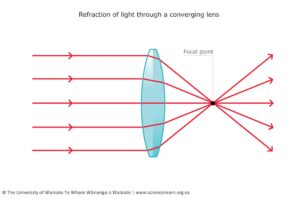
Converging lenses (convex lenses) bend light rays to a focus point.
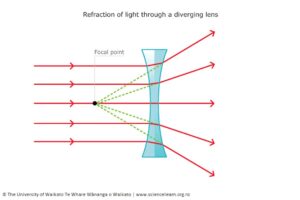
Diverging lenses (concave lenses) bend light away from the focus point.
Prisms separate white light into its color components as Isaac Newton first demonstrated. He also showed that the colors can be recombined to make white light again.
The explanation for the colors separating out is that the light is made of waves. Red light has a longer wavelength than violet light. The refractive index for red light in glass is slightly different than for violet light. Violet light slows down even more than red light, so it is refracted at a slightly greater angle.
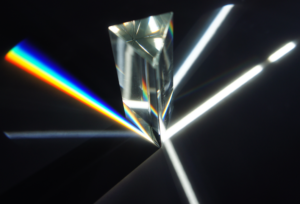
Photo by Kelvinsong
Refraction makes it possible for us to have lenses, magnifying glasses, prisms and rainbows. Our eyes even depend upon this bending of light. Without refraction, we wouldn’t be able to focus light onto our retina.
Learn more: (external links)