

POPtics Light Pipes
Overview: Light pipes use Total Internal Reflection, also known as TIR, to transmit data via light. TIR is what makes internet connections possible. TIR occurs at something called a critical angle where light cannot escape from one medium to another and therefore bounces back and forth within the medium. With very minimal data loss you can send information via light waves through fiber optics, a type of light pipe, because the light will stay contained within the fiber.
Supplies: Laser pointer and/or flashlight, light pipe
Objectives: What does light do when it hits a surface? How does light reflect? What is total internal reflection?
Setup:
- Use the LED flashlight/red laser pointer and the light pipe
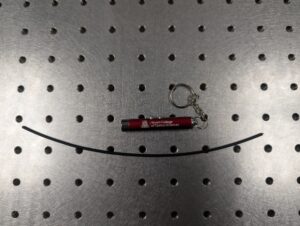
How to run the demo:
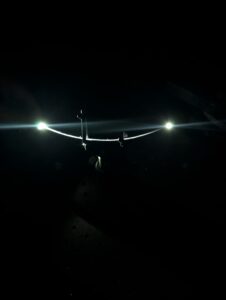
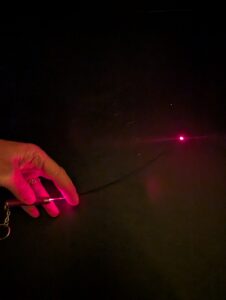
- Shine either light source through one end of the light pipe by placing the light source directly on the end of the light pipe.
- Observe the light exiting through the other end of the light pipe (do not look directly at the light)
- Bend and manipulate the light pipe. Does the intensity of the exiting beam change?
Reminder: The provided laser pointers are eye-safe, but be sure to practice general laser safety and do not look directly into the laser.
What’s Happening?
The laser light stays within the light pipe due to Total Internal Reflection (TIR). This can occur when light reaches a boundary between materials with a higher index of refraction (clear plastic, in this case) and a lower index of refraction (air, yes there is a small amount of air between the clear plastic and the black sheath). If the light approaches this boundary at the critical angle, then the light will reflect and stay within the material.
This is a demonstration of how optical fibers work! Light reflects along the inside of the fiber, so the light stays completely contained within the fiber and can be guided and detected at the other end.
Learn more: (external links)