

POPtics Laser Diffraction
Overview: Different types of light bulbs operate with different principles, and this leads to unique emission spectra. Diffraction glasses can be used to observe differences in various light sources.
Supplies: Diffraction card, red laser
Objectives: What is the electromagnetic spectrum? What wavelengths do our eyes see? How do different types of light bulbs work?
How to use the glasses:

- Put the diffraction glasses on
- Look at various light source (DO NOT LOOK AT THE SUN!!!) and compare the different diffraction patterns you see
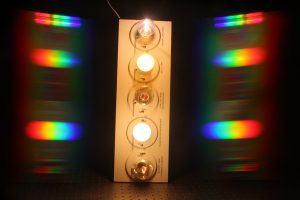
What’s Happening?
White light can be separated into all seven major colors of the complete spectrum or rainbow by using something called a diffraction grating. A grating separates light into colors as the light passes through the many fine slits of the grating. Each color travels at a different speed and therefore has a different angle of refraction, when it hits the grating. The angle of refraction, or rather the changing direction of light, produces the colors seen. When light passes through a grating it is called a transmission grating. There are also reflection gratings. A reflection grating is a shiny surface having many fine grooves. A compact disc makes a good reflection grating.
There are three types of light bulbs you may encounter in your everyday life. You may see incandescent (though much more rare these days), fluorescent or LED. Incandescent bulbs send electricity through a filament, which glows when heated to a high temperature. In fluorescent bulbs Argon gas is excited by electricity. The excited gas generates UV light which in turn excites the phosphor coating on the inside of the bulb to generate the visible light. An LED is a light emitting diode. An electric current passes through a diode which causes an energy excitement that causes an energy release that we see as photons, or light.